PUBLIC DISCUSSION01

What do you honestly think happens to us after we die?
THE QUESTION HUMAN BEINGS NEVER STOP ASKING
I spent fourteen years trying to answer a question I once thought was already settled.
THE ARGUMENT WAS ALREADY HAPPENING
Some say consciousness simply stops. Some expect judgment. Some expect another life. Some admit they do not know. The disagreement is ancient. The certainty is newer.
What do you honestly think happens to us after we die?

Does consciousness end when the brain ends?

If there was nothing before birth, why expect anything after death?
THREE THREADS. THREE ASSUMPTIONS. ONE MISSING STEP.
Public Reddit discussions shown for context. They are not endorsements of this book.
SEVEN YEARS LATER
I had stopped bringing the question up to most people. It sounded too strange, too heavy, too easy to dismiss. But it never really left my head. So I started writing.
Not a book at first. Notes. Arguments. Objections. Things I thought I believed and could no longer explain.
“u think i'm crazy for still thinking about that conversation with the old truck driver?”
I WENT BACK TO WRITING.
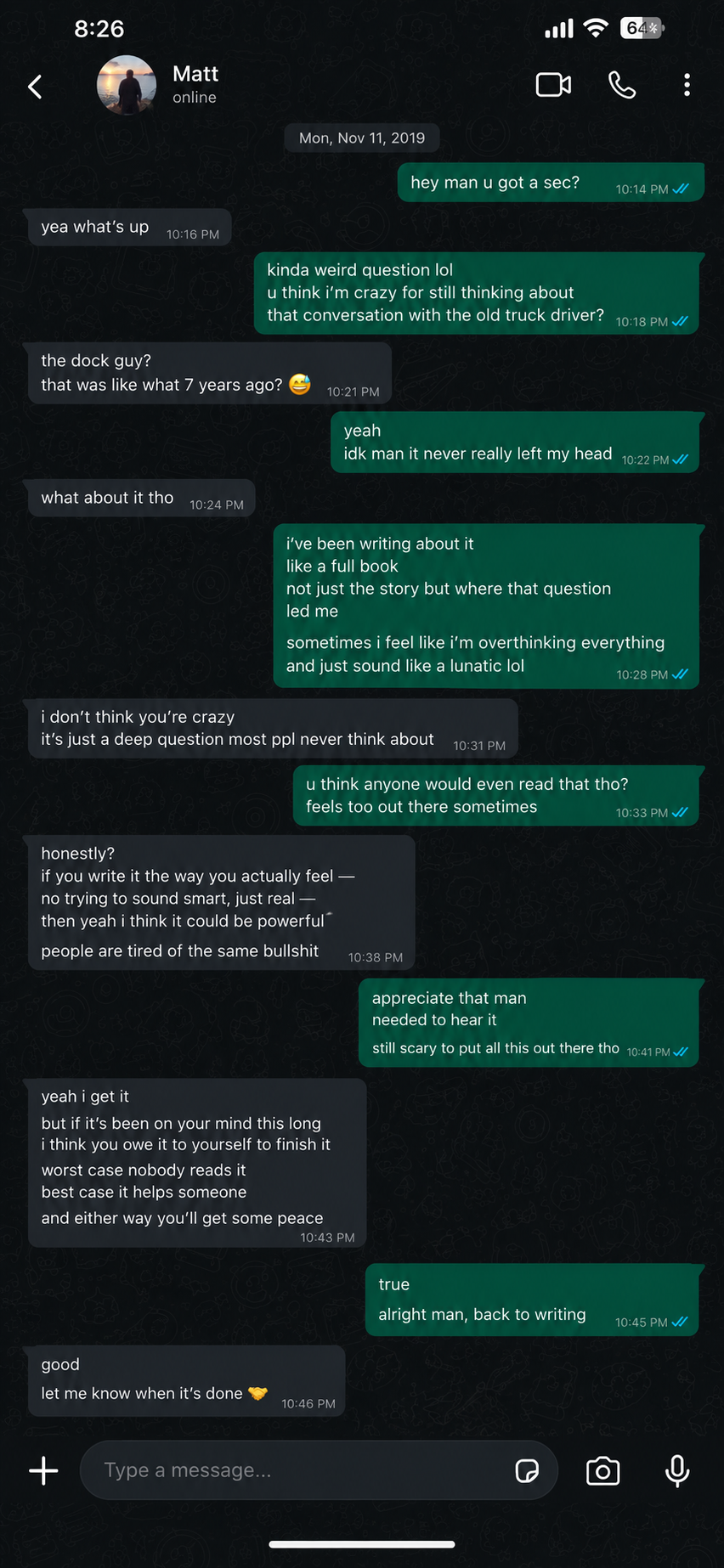
This message image is a dramatized reconstruction used to represent the fictionalized narrative of the book.

THE SEARCH BECAME A BOOK
23 CHAPTERS. 14 YEARS. ONE QUESTION.
Most people live as if time is unlimited. Decisions are postponed. Conversations wait. Years disappear into routines.
Then one question changes the frame: what if death is not simply the end, but the boundary of a world you cannot yet access?
You may not finish this book believing what I believe. But you may never look at your life the same way again.
This book does not ask you to believe me. It asks whether you can still afford not to question.
FOUR WAYS PEOPLE FRAME THE END
Every theory begins with a picture of reality: what consciousness is, what a human being is, whether God exists, and whether death is a wall or a door.
The brain stops. Consciousness stops. There is no experience after death.
Death is not disappearance but entry into accountability before God.
The self continues through another life, form, or cycle of existence.
We do not have access to the other side, so certainty in either direction may exceed the evidence.
I spent years arguing with the answers. Then I noticed the question underneath them.
THE QUESTION I COULDN'T GET RID OF
YOU COULDN'T SEE THE SKY.
YOU COULDN'T SEE YOUR MOTHER'S FACE.
YOU COULDN'T IMAGINE THE WORLD WAITING OUTSIDE.
IT EXISTED ANYWAY.
That does not prove another world exists. It does something more uncomfortable: it exposes how little certainty can actually prove.
WHERE THIS STARTED
I was working nights in a warehouse. Same people. Same routine. I thought I knew what death meant because I had never seriously questioned it.
I told a coworker, Daniel, that he had plenty of time. Less than two hours later, he was dead.
A few nights later an older truck driver asked me a question about the world before birth. The conversation lasted roughly twelve minutes. I never saw him again.
The question kept returning. Death became consciousness. Consciousness became God. God became revelation. I kept following it long after I wished I could stop.
WHAT CHANGED FIRST
Once I stopped treating time as guaranteed, ordinary choices started carrying different weight. What I postponed. Who I called. What I believed without examining. What I kept doing simply because everyone else did it.
Time stopped feeling abstract. 'Later' no longer sounded like a guarantee.
Small choices looked different when I imagined them from the end of a life.
I became less interested in what felt comfortable and more interested in what could survive examination.
I noticed how easily routine, noise and distraction can consume a life without ever answering what it is for.
A question about what happens after death can become a question about what you are doing before it.
WHERE THE QUESTION LED
Every answer opened another door. The search moved from death to consciousness, from consciousness to God, from God to revelation, and from revelation to the claims people build their lives around.
Are we describing the end, or only the limit of what can be observed from this side?
Is the mind nothing more than the brain, or is dependence being confused with identity?
If reality is larger than perception, the question of a Creator becomes harder to avoid.
What did he claim, what did his earliest followers believe, and what came later?
A tradition I had reduced to stereotypes forced me to reread questions I thought belonged somewhere else.
Not the answer I preferred. The answer that could survive my objections.
START AT THE NIGHT IT CHANGED
Meet Daniel. Read the sentence I wish I had never said. Then meet the stranger who asked the question that followed me for fourteen years.
CHAPTER ONE
“You have plenty of time.”
I have repeated those words to myself so many times over the last fourteen years that I no longer know whether I remember saying them, or whether I remember remembering them.
There is a difference.
Memory becomes unreliable when you visit it too often. Every time you return to a moment, you touch it. Move something. Emphasize one detail and forget another. Eventually, you can become more certain about the story than you are about what actually happened.
But I know I said those words.
And I know Daniel heard them.
What I cannot remember is whether he smiled.
For years, I was certain he did. I could see it clearly: Daniel looking down into his paper cup, giving me that tired half-smile of his, as if I had just said something only a twenty-seven-year-old could say.
Now I'm not sure.
Maybe I've given him that smile because I needed his last moment with me to have one.
What I remember without effort is the coffee machine. It stood against the wall of the break room, between a vending machine that ate dollar bills and a bulletin board nobody read. The coffee cost a dollar twenty-five. Daniel complained about the price almost every night and then bought it anyway.
He said it tasted like someone had boiled cardboard.
I thought it tasted worse.
It was Tuesday, sometime in the fall. I could tell you the exact date if I went looking for it, but I don't want to. Dates make things look important after the fact. There had been nothing important about that Tuesday when we were living it.
That is what matters.
It was an ordinary Tuesday.
I remember the time, though.
9:47 p.m.
There was a cheap clock above the break-room door, and Daniel looked at it while we were talking. I followed his eyes without thinking. That is the only reason I know.
9:47.
Less than two hours later, he would be dead.
The rest of the chapter follows the ordinary night that made the sentence impossible to forget.
CONTINUE WITH THE BOOK →“You have plenty of time.”I said it less than two hours before Daniel died.
WHO IS EVAN NORVALECK?
For fourteen years, I kept returning to a conversation that lasted twelve minutes.
I don't know the man's name.
I never saw him again.
I can no longer trust myself to describe his face.
But I remember the question.
It came a few nights after a man I worked beside died.
Less than two hours before his death, I had told him:
“You have plenty of time.”
I was twenty-seven.
I worked nights in Pennsylvania. I believed death was the end. Not because I had investigated it.
Because I had never found a reason to doubt it.
Then a stranger asked me to remember a world I had already lived in.
I couldn't.
That should have been the end of it.
It wasn't.
What began as a question about death eventually reached consciousness. God. Jesus. Revelation. And places I had never expected to look.
I changed my mind more than once.
Some questions disappeared.
Others became harder to escape.
And somewhere in those fourteen years, I found an answer I had not been looking for.
I won't tell you what happened next here.
Not because it is a secret.
Because if I reduce fourteen years to a paragraph, you will know where I ended up without understanding what it took to get there.
Evan Norvaleck is the name I chose to put on that journey.
No photograph.
No public identity.
Just the record of what happened after one ordinary night made certainty impossible.
If you want to know who Evan Norvaleck is, don't look for the man.
Follow the question.
“If something in these pages disturbs your certainty, don't replace it with mine. Keep looking.”
“If something in these pages disturbs your certainty, don't replace it with mine. Keep looking.”
BEFORE YOU OPEN IT
No. The analogy is used to challenge certainty, not manufacture proof. The book follows what happens when that uncertainty is taken seriously.
Yes, because Evan's search eventually reaches God, Christianity, Jesus, Islam and revelation. It does not begin by asking the reader to accept any of them.
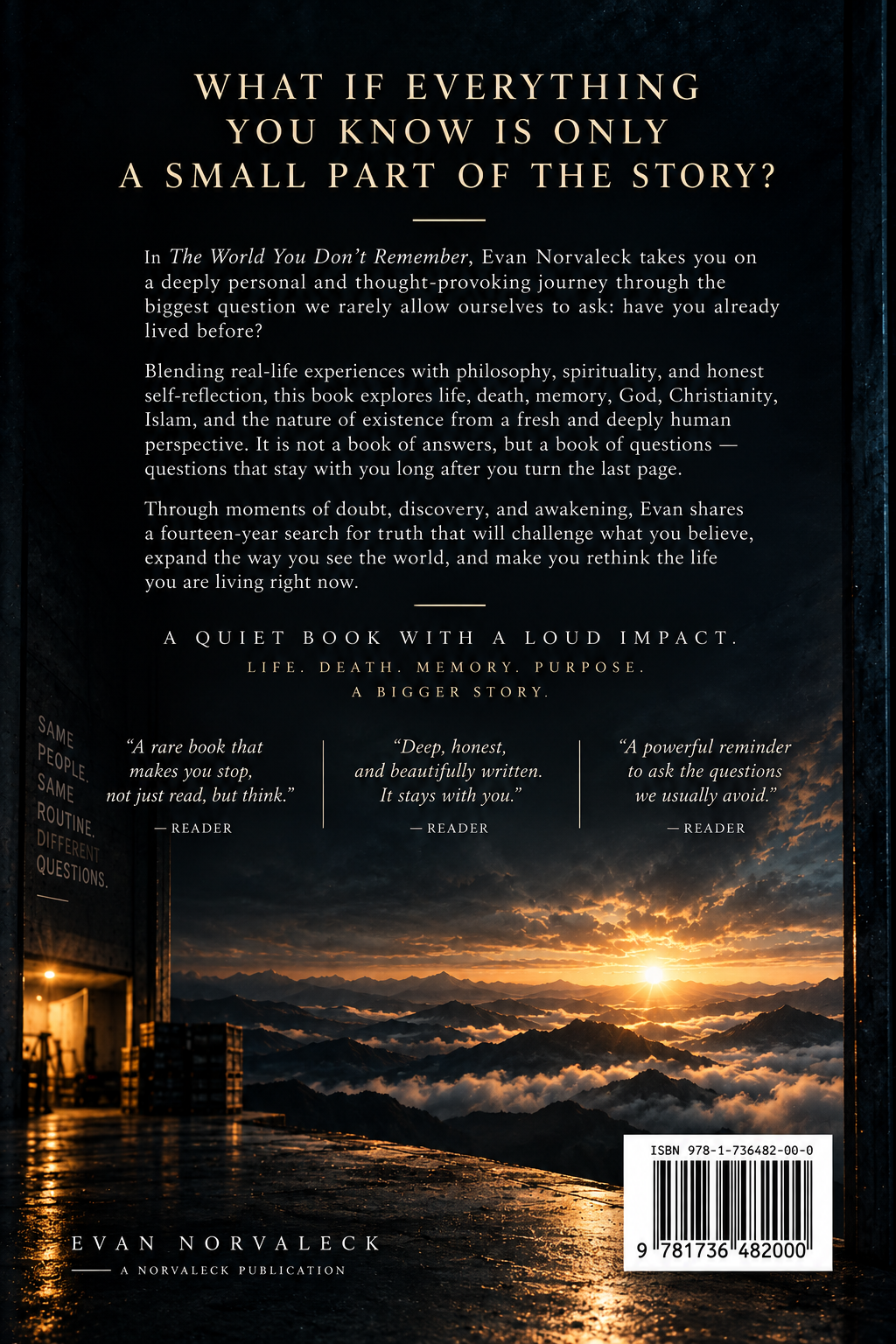
The current edition is a digital eBook. The live Shopify product above shows the current price and checkout details.
Yes. The opening chapter is available so you can decide whether the voice and the question are worth following.
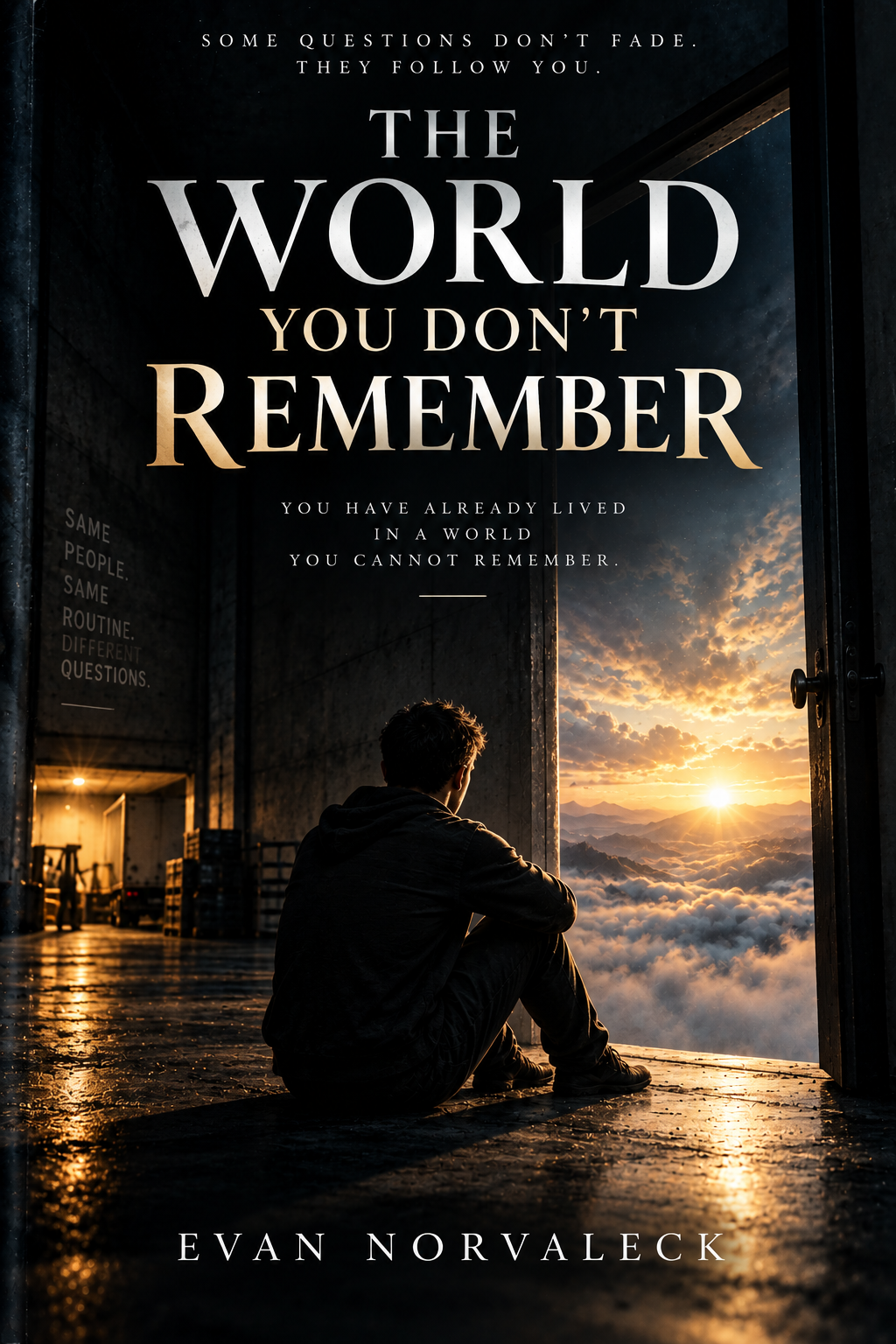
ONE LAST QUESTION
Maybe death is the end. Maybe it is not. But living as though the answer could never matter is still a choice.